

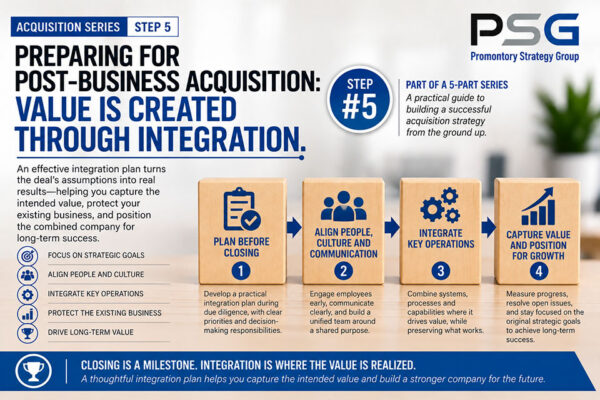
 This is part 5 of a five-part series discussing the critical steps a privately held company needs to take to succeed with a strategic M&A initiative. For additional articles and videos, please visit https://promstrategy.com/psg-news/ and https://www.youtube.com/@riegginsights.
Closing an acquisition is a major milestone, but it is not where the work ends. Once the documents are signed and ownership changes hands, leadership must turn the deal’s assumptions into day-to-day results. For privately held and family-owned companies, the post-business acquisition period is where much of the expected value is either realized or lost.
That makes integration more than an operational clean-up exercise. The buyer needs to protect the business it already owns, stay focused on why it pursued the target, and put people in place to manage the transition without letting important decisions drift. A good integration plan starts with a clear understanding of what the acquisition was meant to accomplish.
Step 5: What Matters Most Post-Business Acquisition?
The first four steps in this series focused on preparing for and completing the transaction. Ownership established the reason for pursuing an acquisition, defined the right target, assembled experienced advisors, and followed a disciplined process to identify and evaluate opportunities.
Step 5 shifts the focus from closing the deal to making it work.
That distinction matters because the strategic rationale established at the beginning does not automatically become reality at closing. If the buyer acquired a company to gain new customers, expand into another market, add a capability, or improve profitability, the integration effort needs to be organized around delivering those outcomes.
This is also where the earlier planning begins to connect. Step 1 of the series focused on defining the original purpose behind the acquisition. Step 2 established the characteristics the right target needed, and Step 3 addressed the advisors needed to move the transaction forward. Those decisions should not disappear once the purchase agreement is signed.
Integration Planning Should Begin Before Closing
It is easy to think of integration as something that happens after the transaction. In practice, leadership should be discussing post-acquisition integration planning well before the closing date.
During due diligence, the buyer is already learning how the target operates. Management is reviewing people, systems, customers, suppliers, processes, reporting, technology, and financial performance. Those findings provide an early look at what may be straightforward to integrate and where problems could arise.
If the buyer waits until closing to ask basic questions, it can lose valuable time. Employees may not know who is making decisions, customers may hear inconsistent messages, and management can find itself responding to urgent issues instead of following a plan.
An acquisition integration plan does not need every answer before closing. Some decisions depend on information that will not be available until later. Leadership should, however, have a working view of priorities, decision-making responsibilities, and the areas that need immediate attention when the transaction closes. This is especially important when the buyer has spent months focused on valuation, financing, diligence, and legal documents. The finish line of the transaction can feel like the end of the process when, operationally, it is the beginning of a very different one.
Do Not Let the Acquisition Distract From the Existing Business
One of the most practical points in our integration framework is also one of the easiest to underestimate: the acquisition cannot become a distraction to the buyer.
The existing company still has customers to serve, employees to lead, orders to fill, suppliers to manage, and financial goals to meet. An acquisition can introduce a second set of employees, customers, systems, and operational issues almost overnight. Without clear responsibilities, executives can become consumed by the new business while core performance begins to slip.
A sound business acquisition integration strategy accounts for both sides of that equation. Leadership needs enough visibility into the acquired company to make good decisions, but the entire executive group cannot spend every day working on integration issues.
This is one reason the integration structure matters. Responsibilities need to be distributed so the people operating the existing business can keep doing their jobs while dedicated leaders manage specific integration priorities.
The goal is not to move as quickly as possible on every issue. Some processes may need immediate attention, while others are better left alone until leadership has more information. A deliberate pace can reduce unnecessary disruption and give employees on both sides time to understand what is changing and why.
Keep the Original Acquisition Priorities at the Forefront
The longer a transaction takes, the easier it can be to lose sight of the reason it began. By closing, management may have spent months thinking about price, financing, legal terms, diligence findings, and deadlines. Those issues matter, but they are not the reason the business was acquired.
The original strategic rationale for an acquisition should remain visible during integration. If the objective was geographic expansion, leadership should watch whether the combined company is gaining traction in that market. If the target was acquired for a specialized capability, the integration plan should address how the buyer will retain, support, and introduce that capability to its customers.
The same thinking applies to customers, talent, technology, and operational synergies. Leadership should be able to connect important integration workstreams to the value the transaction was expected to create.
This is where the company’s earlier acquisition criteria can remain useful. Those criteria helped define why a target was attractive before the transaction. After closing, they can provide a reminder of which characteristics and capabilities need to be protected rather than accidentally disrupted during the transition.
Build a Dedicated Integration Structure
Integration becomes difficult when everyone is responsible for it in theory, but no one clearly owns it in practice. The buyer needs a dedicated integration team with defined responsibilities and a way to move decisions from leadership down to the people doing the day-to-day work.
Chris Riegg’s framework breaks that structure into three practical levels: a steering committee, key functional leaders, and functional teams.
Steering Committee
The steering committee provides direction and keeps integration connected to the transaction’s larger objectives. Depending on the organization, this group may include ownership, the CEO, CFO, and outside advisors.
Its role is not to manage every operational detail. The committee should address significant priorities, remove roadblocks, review progress, and make decisions that affect the overall direction of the combined business.
For a family-owned company, this layer can be particularly useful because ownership objectives may extend beyond near-term operating results. Questions involving capital, management roles, shareholder priorities, and long-term strategy may need to be considered alongside traditional integration issues.
Key Functional Leaders
Below the steering committee, key functional leaders translate the broader integration goals into specific integration workstreams. These leaders may represent finance, operations, sales, human resources, technology, supply chain, or other areas that matter to the businesses involved. Their job is to define what needs to happen within their function, establish priorities, coordinate resources, and keep the work moving.
This layer also helps identify conflicts between functions. A change that makes sense from an accounting perspective may create challenges for operations. A sales decision may affect technology or customer service. Functional leaders can surface those issues before they turn into larger problems.
Functional Teams
Functional teams handle the day-to-day work of bringing the businesses together. They may address practical issues such as reporting procedures, system access, customer communication, purchasing processes, payroll, vendor relationships, or operating policies.
This is where M&A integration planning becomes very tangible. Employees who understand the actual work often see problems that are difficult to identify from an executive-level integration plan.
Their involvement can also improve communication. Rather than having every change delivered from the top, the people responsible for each area have a clearer understanding of what is happening, what needs to change, and what should remain in place.
Integration Does Not Mean Changing Everything at Once
A buyer can create unnecessary problems by assuming that every target process needs to be replaced immediately. The acquired company may have systems, customer relationships, employee practices, or operating methods that work well. Some of those may even be part of what made the company attractive in the first place.
A thoughtful post-close integration process separates what truly needs to change from what can remain in place. Leadership should consider where standardization creates value and where forcing the buyer’s existing practices onto the target could disrupt operations without meaningful benefit.
Culture deserves similar attention. Employees in the acquired company will be watching what leadership does, not simply what it says. Sudden changes to responsibilities, communication, benefits, reporting relationships, or familiar ways of working can affect retention and morale.
The buyer does not need to preserve every part of the old organization. It does need to understand what it is changing before it changes it.
Learn From Other Companies That Have Been Through It
One of the most useful recommendations in Chris Riegg’s framework is to speak with business leaders who have already integrated acquisitions, including those whose integrations did not go as planned.
Successful transactions can provide ideas for governance, communication, employee retention, and operational planning. Difficult integrations can be just as valuable because they reveal where leadership underestimated complexity, moved too quickly, waited too long, or overlooked an issue that became more significant after closing.
That perspective is particularly useful for privately held businesses that do not acquire companies regularly. An owner may complete only a few transactions over an entire career, while another executive or advisor may have seen the same integration challenge several times.
The experienced advisory group discussed in Step 3 can remain valuable during this period as well. Legal, accounting, lending, tax, and transaction advisors may each have experience with issues that continue after closing, and they can provide context as leadership decides how to respond.
Promontory Strategy Group also addresses the importance of integration in its broader discussion of the risks and rewards of business acquisition, including the risk of waiting too long to plan for what happens after the transaction.
In this Riegg Insights video on preparing for post-acquisition integration, Chris Riegg discusses Step 5 of the process and why closing the transaction is only the beginning of creating value from the acquisition.
“The value anticipated in an acquisition must be earned after closing. Integration planning should begin during diligence, assign clear accountability, and protect the existing business while the combined organization works toward the objectives that justified the transaction.”
— Christopher Riegg, CFA, CPA, Partner at Promontory Strategy Group
Post-Business Acquisition Success Depends on What Happens Next
A thoughtful post-business acquisition plan keeps the buyer focused on the same priorities that made the transaction attractive in the first place. It protects the existing business, creates clear accountability for integration, and gives functional leaders the structure they need to work through the practical issues that appear after closing.
No integration will unfold exactly as expected. Employees will raise questions, systems will work differently than anticipated, and some assumptions made during diligence will need to be revisited. The objective is not to eliminate every surprise. It is to give leadership a disciplined way to respond without losing sight of the value the acquisition was meant to create.
Promontory Strategy Group works with privately held and family-owned companies as they evaluate and execute strategic acquisitions, including the planning that connects the transaction to longer-term value creation. Contact Promontory Strategy Group to discuss how post-acquisition integration fits into your company’s broader M&A strategy.
Why Promontory Strategy Group?
Established by Christopher Riegg, CFA, CPA, Promontory Strategy Group provides independent strategic and financial advisory services to privately held and family-owned businesses evaluating ownership transitions, acquisitions, and long-term growth initiatives.
We bring investment banking discipline and transaction experience to critical decisions and engage earlier in the process, before a formal transaction is underway. This allows owners and leadership teams to evaluate options with greater clarity, align stakeholders, and prepare thoughtfully rather than react under time pressure.
PSG works alongside a company’s existing trusted advisors: legal, accounting, and lending partners, providing an objective market perspective on valuation, capital structure, and transaction alternatives. Our role is to help translate strategy into executable plans that preserve flexibility and maximize long-term value.
In situations where timing, preparation, and alignment matter most, an experienced perspective applied early can materially influence outcomes.
If you are beginning to think about a business ownership transfer, engaging in pre-transaction advisory early can help you understand your options and prepare with intention.

By Christopher Riegg
Christopher Riegg is an investment banking professional with over three decades of experience providing strategic and financial guidance to business owners and executives. As a partner at Promontory Strategy Group, Christopher Riegg has worked with over 200 companies across various industries, including manufacturing, distribution, technology, and services. His focus areas include mergers and acquisitions, debt restructuring, recapitalization, and private equity capital.
