

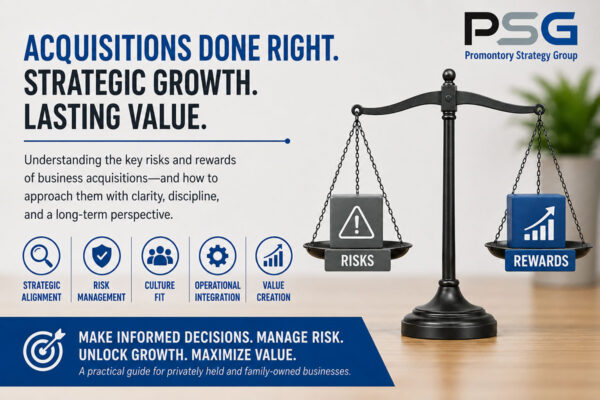
 A business acquisition can give a privately held or family-owned company access to new customers, capabilities, products, and geographic markets much faster than organic growth alone. It may also strengthen the company’s competitive position or create meaningful leadership opportunities for the next generation.
The potential rewards are significant, but so are the risks. Acquisitions can lose momentum when the strategic rationale is unclear, leadership lacks the time or experience to manage the process, or integration planning begins too late. Before moving forward, ownership and leadership need to understand not only what a potential acquisition could add, but also what it will require from the organization.
Why Privately Held Companies Pursue Acquisitions
Acquisition activity is often described as a way to make a company bigger. For most privately held and family-owned businesses, however, size alone is rarely the primary objective. The strongest acquisition strategy begins with a specific long-term goal.
Accelerating Growth
An acquisition can add revenue, customers, and market presence more quickly than building each of those areas internally. This may be especially valuable when organic growth has slowed, a market opportunity is time-sensitive, or a company has reached the limits of its current sales channels.
The opportunity should still be evaluated in the context of sustainable growth. Additional revenue does not necessarily create additional value if the acquired company has weak margins, high customer concentration, or operational problems that will require significant time and capital to address.
Adding Products and Capabilities
A company may use a strategic acquisition to obtain technology, specialized services, intellectual property, talent, equipment, or manufacturing capabilities that could take years to develop internally. This can help the buyer respond more quickly to changing customer needs and offer a broader range of solutions. The strategic value is strongest when the new capabilities fit naturally with the company’s existing business and can be supported by its sales, operational, and financial infrastructure.
Entering New Geographic Markets
Buying an established company can provide immediate access to a new regional or national market. The buyer may gain existing customer relationships, facilities, employees, supplier connections, and local market knowledge.
A geographic expansion should be evaluated beyond the target company’s address or service territory. Leadership must determine whether the business can be effectively managed across a larger footprint and whether the buyer understands the competitive, regulatory, and cultural conditions of the new market.
Strengthening the Company’s Competitive Position
Acquiring a competitor or complementary business may increase market share, improve operating scale, and deepen relationships with customers and suppliers. It may also reduce reliance on a narrow group of products, markets, or accounts.
For family ownership groups, the objective may be broader than near-term financial performance. A carefully selected acquisition can support long-term shareholder value, make the company more resilient, and strengthen its ability to remain independent.
Creating Succession and Leadership Opportunities
A family-owned business acquisition can also support succession planning. A larger or more diversified company may create new responsibilities for next-generation family members and other emerging leaders. This can be valuable when the next generation is interested in continuing the business but needs room to develop. The acquisition should not be used simply to create titles or positions, however. New leadership responsibilities must align with the individuals’ abilities, experience, and long-term interests.
What Are the Primary Risks?
Many acquisition initiatives begin with enthusiasm. Problems often arise because important strategic, financial, and operational questions were not addressed early enough.
An Unclear Strategic Rationale
One of the greatest sources of M&A risk is pursuing a target because the opportunity appears attractive rather than because it supports a clearly defined growth strategy. A company may become interested in an acquisition after receiving an unsolicited call, learning that a competitor is for sale, or recognizing that financing is available. Those circumstances may justify further exploration, but they are not a substitute for strategic rationale.
Ownership should be able to explain why the acquisition is being considered, what it is expected to accomplish, and how it supports the company’s long-term direction.
Undefined Acquisition Criteria
Without defined acquisition criteria, leadership may spend considerable time evaluating businesses that do not fit. Criteria commonly address factors such as:
- Industry and market segment
- Revenue and earnings
- Geographic footprint
- Products and capabilities
- Customer concentration
- Management depth
- Cultural compatibility
- Purchase price and financing requirements
Clear parameters make it easier to screen opportunities objectively. They can also prevent leadership from becoming overly attached to a particular deal before fully evaluating its fit.
Limited Internal Bandwidth
Leadership groups often underestimate how much time an acquisition will require. Executives must continue operating the existing company while sourcing targets, reviewing financial information, arranging financing, completing negotiations, conducting diligence, and planning integration.
This can put pressure on day-to-day operations and delay important internal initiatives. Before beginning an acquisition process, the company should determine who will lead the work, which responsibilities can be delegated, and where outside support may be needed.
Inexperienced Transaction Leadership
Privately held companies may complete acquisitions only a few times during their existence. Sellers, lenders, investors, and other parties involved in the transaction may have far more experience. Valuation, negotiation, acquisition financing, deal structure, and diligence each require specialized judgment. Without experienced transaction leadership, a buyer may overlook significant risks, accept unfavorable terms, or lose leverage during negotiations.
Integration Planning That Begins Too Late
The value of an acquisition is not created when the agreement is signed. It is realized through successful post-acquisition integration.
Waiting until after closing to develop an integration plan can lead to confusion over leadership, reporting structures, systems, employees, customers, suppliers, and company culture. Uncertainty can quickly affect morale and customer confidence.
Integration planning should begin during the evaluation process. Leadership should understand how the companies will operate together, who will be responsible for key decisions, and how progress will be measured after closing.
“An acquisition earns its place in a growth strategy when the expected benefits justify the capital, management attention, and integration work it requires. Ownership needs a clear view of both the opportunity and the organization’s ability to deliver on it.”
— Christopher Riegg, CFA, CPA, Partner at Promontory Strategy Group
How to Evaluate a Business Acquisition Before Moving Forward
A disciplined evaluation begins by separating the attractiveness of the opportunity from its strategic and financial fit. Ownership and leadership should consider several questions:
- What long-term objective would this acquisition support?
- Could the same objective be achieved through organic growth or another investment?
- What capabilities, customers, or market access would the target provide?
- What financial and operational risks could reduce the expected value?
- Does the company have enough leadership capacity to complete and integrate the transaction?
- How would the purchase be financed?
- What effect could the acquisition have on ownership control, liquidity, and risk?
- How will the two companies operate together after closing?
- What would cause leadership to stop pursuing the transaction?
Thorough due diligence for a business acquisition is an important part of this evaluation, but diligence should not be treated as a checklist performed only near the end of the process. Strategic, operational, financial, legal, tax, and cultural questions should be examined throughout the transaction.
Just as importantly, ownership should define acceptable terms and potential deal breakers before negotiations become advanced. This helps leadership maintain objectivity when time, money, and emotion have already been invested.
Finding the Right Balance Between Opportunity and Risk
The most successful acquisition is not necessarily the largest target or the deal with the highest projected revenue. It is the opportunity that best supports the company’s long-term goals while presenting risks that ownership understands and can responsibly manage.
For privately held and family-owned businesses, the decision may also affect family legacy, next-generation leadership, ownership control, and the company’s continued independence. These considerations deserve the same attention as valuation and financing.
A thoughtful business acquisition process provides ownership and leadership with the perspective needed to evaluate the opportunity, prepare the organization, and make a decision with greater clarity. Promontory Strategy Group advises privately held and family-owned companies as they assess strategic growth opportunities, prepare for transactions, and navigate important financial decisions. Contact Promontory Strategy Group to discuss whether an acquisition aligns with your company’s long-term objectives.
Why Promontory Strategy Group?
Established by Christopher Riegg, CFA, CPA, Promontory Strategy Group provides independent strategic and financial advisory services to privately held and family-owned businesses evaluating ownership transitions, acquisitions, and long-term growth initiatives.
We bring investment banking discipline and transaction experience to critical decisions and engage earlier in the process, before a formal transaction is underway. This allows owners and leadership teams to evaluate options with greater clarity, align stakeholders, and prepare thoughtfully rather than react under time pressure.
PSG works alongside a company’s existing trusted advisors: legal, accounting, and lending partners, providing an objective market perspective on valuation, capital structure, and transaction alternatives. Our role is to help translate strategy into executable plans that preserve flexibility and maximize long-term value.
In situations where timing, preparation, and alignment matter most, an experienced perspective applied early can materially influence outcomes.
If you are beginning to think about a business ownership transfer, engaging in pre-transaction advisory early can help you understand your options and prepare with intention.

By Christopher Riegg
Christopher Riegg is an investment banking professional with over three decades of experience providing strategic and financial guidance to business owners and executives. As a partner at Promontory Strategy Group, Christopher Riegg has worked with over 200 companies across various industries, including manufacturing, distribution, technology, and services. His focus areas include mergers and acquisitions, debt restructuring, recapitalization, and private equity capital.