

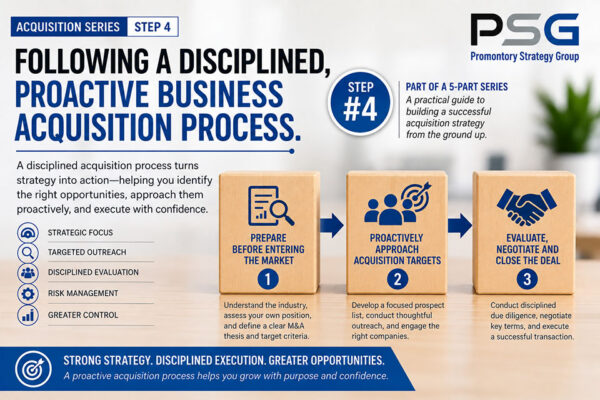
 This is part 4 of a five-part series discussing the critical steps a privately held company needs to take to succeed with a strategic M&A initiative. For additional articles and videos, please visit https://promstrategy.com/psg-news/ and https://www.youtube.com/@riegginsights.
A company that has decided to grow through acquisition can take two very different paths. It can wait for opportunities to arrive through brokers, competitors, or business contacts, or it can enter the market with a clear idea of what it wants and a plan to find it. For privately held and family-owned companies, the second path usually gives management much more control over where it spends its time.
A disciplined acquisition process turns the strategy, target criteria, and advisory resources established in the earlier steps into action. Rather than reacting to whichever company happens to come up for sale, leadership can study the market, prioritize potential targets, approach them thoughtfully, and narrow the field as more information becomes available.
Step 4: How Does a Disciplined Acquisition Process Work?
The earlier steps in this series focused on the “why,” “what,” and “who” of an acquisition. Ownership first establishes the strategic reason for pursuing a transaction, defines what a suitable target should look like, and brings together experienced advisors who can help execute the plan. If you are starting at the beginning, Step 1 of the series explains why that strategic foundation should come before the search.
Step 4 is the “how.” This is where planning moves into execution through a proactive M&A process that can generally be viewed in three phases: preparation, outreach, and closing the deal.
Those phases are not simply administrative steps. Each one gives the buyer another opportunity to test its assumptions and decide whether a target still deserves additional time, attention, and capital.
Phase 1: Prepare Before Entering the Market
A proactive acquisition effort should not begin with a list of companies and a round of phone calls. The buyer first needs to understand the industry, its own position within that market, and the types of businesses that could realistically advance its strategy.
Promontory Strategy Group generally frames this preparation period as approximately 60 to 90 days. Exact timing depends on the market and the buyer, but the purpose is the same: do enough work up front so outreach is focused rather than speculative.
Assess the Industry
An M&A industry assessment helps leadership understand the environment in which potential targets are operating. This may include market size, growth trends, competitive dynamics, customer behavior, consolidation activity, regulatory issues, and other factors that could affect the sector’s attractiveness.
This work can also challenge assumptions made earlier in the planning process. A market that looked attractive from a distance may be more fragmented, competitive, or capital intensive than expected. Another may contain opportunities that were not obvious when the strategy was first discussed. The objective is not to know everything about an industry before speaking with a target. It is to understand enough of the landscape to recognize which companies warrant a closer look and which are less likely to fit.
Look at the Buyer Just as Closely
The buyer also needs an honest view of its own position. Company and buyer analysis should consider financial capacity, management depth, operational strengths, existing customer relationships, geographic reach, and the capabilities the organization can realistically support after closing.
A company may identify a desirable target that is simply too large for its current management structure. Another opportunity may make strategic sense but require an investment in systems, facilities, or working capital that changes the transaction’s economics. Looking inward before going to market helps leadership distinguish between a target that is appealing and one the organization is actually prepared to own.
Turn the Strategy Into an M&A Thesis
The information gathered during preparation should eventually come together in an M&A investment thesis and defined target criteria. This gives the search a clear “strike zone.”
The thesis explains what the buyer believes it can accomplish through an acquisition and the type of business most likely to deliver that result. From there, leadership and its advisors can identify and prioritize acquisition candidates rather than treating every company in the market as equally relevant. The goal is not to create an enormous list. A focused group of well-matched prospects gives management a better starting point for the next phase.
Phase 2: Proactively Approach Acquisition Candidates
Once the company identifies priority targets, it can begin outreach. Promontory Strategy Group’s process anticipates that this phase may take roughly 90 to 180 days or longer, particularly when the buyer is approaching companies that are not actively for sale.
That distinction matters. A proactive acquisition search is different from reviewing a stream of marketed deals. The buyer identifies companies that fit the strategy, then determines whether their owners have any interest in a conversation.
Some contacts will go nowhere. Others may develop slowly over several months. A business owner who is not interested today may become open to a discussion later. A disciplined outreach effort accounts for these realities rather than assuming every target will immediately enter a sales process.
Initiate Outreach With a Reason for the Conversation
Initial outreach should make sense from the target owner’s perspective. The buyer should be able to explain why the company caught its attention and why a conversation may be worthwhile.
This is one reason acquisition target screening during Phase 1 matters so much. Outreach based on a clear strategic fit is more credible than simply contacting a large number of businesses to see who might sell.
Promontory Strategy Group may lead this outreach on behalf of a buyer, allowing the initial conversation to remain discreet while management stays focused on operating the business. When interest develops, PSG can help coordinate the exchange of information and the next stages of evaluation.
Use an NDA Before Sensitive Information Changes Hands
As discussions become more serious, the parties typically exchange a non-disclosure agreement in M&A before sharing confidential business information.
The NDA creates a framework for handling sensitive information as the buyer learns more about the target. This may include customer data, financial results, employee information, contracts, pricing, or other information the seller would not ordinarily disclose outside the company.
Signing an NDA does not mean the buyer has decided to proceed. It simply moves the conversation into a more informed stage.
Review the Financials and Begin Valuation
Once sufficient information is available, the buyer can complete a preliminary financial review and valuation. Revenue, margins, EBITDA and Adjusted EBITDA, working capital, debt, capital expenditures, customer concentration, and other financial factors can all influence the buyer’s view of value.
This stage should also test the assumptions behind the original strategy. Does the target perform the way leadership expected? Are earnings sustainable? Will additional investment be required? Does the likely valuation still make sense given the potential return and risk?
The answers may lead the buyer to continue, adjust its expectations, or end the discussion. That narrowing is part of a healthy process. Not every target that enters the funnel should make it to the next phase.
Decide Whether to Submit an IOI or Letter of Intent
If the opportunity continues to make sense, the buyer may submit an indication of interest, commonly called an IOI, or move toward a letter of intent, depending on the circumstances of the transaction.
These documents begin putting economic and structural terms around the discussion. Price or valuation methodology, transaction structure, financing assumptions, timing, exclusivity, and other major terms may start to take shape.
This is also an important point for the buyer’s advisory group to work together. Legal counsel, lenders, accounting advisors, and the lead transaction advisor may each see issues that influence what the buyer is willing to propose.
Phase 3: Move From an LOI to Closing
Signing a letter of intent can feel like a major milestone, but substantial work remains. Promontory Strategy Group’s framework estimates roughly 90 days on average from a signed LOI through diligence, documentation, financing, and closing, though the actual timeline can vary considerably.
In this phase, the buyer takes a much closer look at the company and turns the broad terms of the proposed transaction into binding agreements.
Due Diligence Begins in Earnest
Acquisition due diligence typically expands well beyond the preliminary review completed during outreach. Depending on the business, you may need to examine financial, legal, tax, operational, customer, employee, technology, environmental, and other areas.
The purpose is not simply to search for reasons to stop the deal. Diligence helps the buyer understand what it is acquiring, confirm important assumptions, identify issues that need to be resolved, and determine whether the agreed terms still reflect the realities of the business.
New information may lead to additional questions, changes to the purchase agreement, modifications to price or structure, or new plans for the period after closing. In some situations, the findings may be significant enough that the buyer decides not to proceed.
Finalize Legal Documents and Financing
At the same time, legal counsel works through the purchase agreement and related transaction documents while lenders and other capital providers finalize the acquisition financing structure.
These workstreams are closely connected. Financing terms may affect the transaction structure, while diligence findings can influence lender requirements or legal protections. A disciplined process keeps the advisors communicating rather than allowing each workstream to operate independently.
The buyer should also continue planning for what happens after the transaction. Closing may be the immediate objective, but ownership still needs to be ready to manage employees, customers, systems, reporting responsibilities, working capital, and other integration issues once control changes hands.
Close and Fund the Acquisition
The final stage is closing a business acquisition, when the required agreements are executed, financing is funded, and ownership of the business transfers under the agreed terms.
That moment matters, but it is not when value is fully created. Closing marks the transition from buying the business to owning and integrating it, which is why the final article in this series will focus on preparing for what comes next.
“A proactive acquisition process gives the buyer a reason for each conversation and a framework for each decision. Preparation, focused outreach, and disciplined evaluation help leadership pursue strategic fit while retaining the judgment to step away when an opportunity no longer makes sense.”
— Christopher Riegg, CFA, CPA, Partner at Promontory Strategy Group
A Proactive Search Gives the Buyer More Control
One of the biggest differences between a proactive approach and a reactive one is the size and quality of the opportunity set. Waiting for unsolicited opportunities limits a buyer to companies whose owners happen to be selling at that moment. Some may fit. Many will not. A deliberate search allows the company to start with the market itself and identify businesses based on strategic fit rather than availability alone.
That does not mean every acquisition has to originate through direct outreach. A brokered opportunity can still be an excellent fit. The difference is that leadership already has a framework for judging it instead of allowing the existence of the deal to define the strategy.
A clear M&A timeline and process also helps owners understand the commitment involved. From preparation through outreach and closing, a successful search can take many months. Setting realistic expectations makes it easier to assign internal responsibilities, maintain momentum, and avoid rushing simply because a transaction has begun to feel time-sensitive.
In this Riegg Insights video on following a disciplined, proactive process, Chris Riegg provides additional perspective on Step 4 and the importance of approaching acquisition opportunities with structure rather than relying primarily on deals that happen to appear.
A Disciplined Acquisition Process Keeps the Strategy in Control
A well-run acquisition process gives privately held and family-owned businesses a repeatable way to move from an idea to a completed transaction. Preparation helps the buyer understand the market and prioritize candidates. Proactive outreach creates a stronger pipeline of potential targets. Careful evaluation, diligence, financing, and documentation then narrow that pipeline to opportunities that can withstand a closer look.
The process will not make every deal predictable, nor should it. New information will surface, negotiations will change, and some attractive opportunities will ultimately fall away. The value of a disciplined approach is that those decisions happen within a framework instead of being driven by urgency or by whichever company happens to be available.
Promontory Strategy Group helps privately held and family-owned companies develop and execute proactive business acquisition strategies, from industry and target analysis through outreach, negotiation, due diligence, and closing. Contact Promontory Strategy Group to discuss how a disciplined acquisition search could support your company’s long-term growth objectives.
Why Promontory Strategy Group?
Established by Christopher Riegg, CFA, CPA, Promontory Strategy Group provides independent strategic and financial advisory services to privately held and family-owned businesses evaluating ownership transitions, acquisitions, and long-term growth initiatives.
We bring investment banking discipline and transaction experience to critical decisions and engage earlier in the process, before a formal transaction is underway. This allows owners and leadership teams to evaluate options with greater clarity, align stakeholders, and prepare thoughtfully rather than react under time pressure.
PSG works alongside a company’s existing trusted advisors: legal, accounting, and lending partners, providing an objective market perspective on valuation, capital structure, and transaction alternatives. Our role is to help translate strategy into executable plans that preserve flexibility and maximize long-term value.
In situations where timing, preparation, and alignment matter most, an experienced perspective applied early can materially influence outcomes.
If you are beginning to think about a business ownership transfer, engaging in pre-transaction advisory early can help you understand your options and prepare with intention.

By Christopher Riegg
Christopher Riegg is an investment banking professional with over three decades of experience providing strategic and financial guidance to business owners and executives. As a partner at Promontory Strategy Group, Christopher Riegg has worked with over 200 companies across various industries, including manufacturing, distribution, technology, and services. His focus areas include mergers and acquisitions, debt restructuring, recapitalization, and private equity capital.
